
The Great Irish Famine · County Mayo
Tragedy in Doolough, County Mayo, March 1849
At the end of March 1849, hundreds of starving men, women, and children made a forced overnight journey through one of the most beautiful and unforgiving valleys in the west of Ireland. Most arrived to nothing. Many did not return.
The Doolough Valley in County Mayo is, by most measures, one of the more striking landscapes in the west of Ireland — a long glacial corridor between steep mountains, with the dark lake from which it takes its name occupying the valley floor. In Irish, Doo Lough means “Black Lake.” It’s a stunningly beautiful location. By 1849, however, the dark name of this pass had acquired a different kind of weight.
What took place there on the night of 30 March 1849 was not a battle or a massacre in any conventional sense. It was, in the language of the time, an administrative matter, but the consequences were the same.
Background: relief under the Poor Law
By early 1849, the Great Famine — An Gorta Mór — had already claimed an estimated one million lives. A further 1.5 million had emigrated. The cause was not simply the potato blight: successive years of crop failure were compounded by government policies that continued to prioritise landlord interests and resist any significant public relief effort.
For those who remained in the west of Ireland, “outdoor relief” — a direct allocation of food administered through the Poor Law Unions — represented, in many cases, the only means of survival. Qualification was not automatic. It required inspection and approval by the relevant officials.
The destitute of Louisburgh, a small village in south County Mayo, fell under the jurisdiction of the Westport Poor Law Union.
The march to Delphi Lodge
On Friday 30 March 1849, two officials from the Westport Poor Law Union arrived in Louisburgh to carry out inspections and determine which residents would continue to receive relief. Captain Primrose and Colonel Hogrove departed the village without conducting the inspections. They travelled south to Delphi Lodge — a private hunting and fishing retreat in the valley between the mountains, approximately 12 miles (19 kilometres) away, where they intended to spend the night.
The people waiting in Louisburgh were told to present themselves at Delphi Lodge by seven o’clock the following morning, or be removed from the relief register entirely.
They had no food and no shelter against the weather. Many were already in an advanced state of starvation. Some were barefoot. Some wore only the clothing they slept in which was scant and not waterproof or windproof.
An estimated 600 people — described by contemporaries as “living skeletons” — set out through the mountain pass in darkness. The conditions that night were severe like it can often be in March in Ireland: freezing temperatures, rain, and heavy wind. The journey took them along the edge of the valley, past the lake, and through terrain that would have been difficult for a person in good health. Even today to do this as an overnight journey with food, well rested and with appropriate clothing, would be a challenge.
The reception at Delphi Lodge
Those who survived the overnight trek and reached Delphi Lodge found, on arrival, that the officials could not be disturbed. They were eating lunch. When the meeting eventually took place, the people were turned away without assistance and sent back the way they had come.
Bodies were found along the road in the days that followed. A woman named Dalton was discovered dead alongside her children. Two unnamed men who died within a mile of Louisburgh were left exposed — without burial — for several days. Some of the dead were found with grass in their mouths, their lips stained green — eaten in the final desperate stages of starvation. Grass is mostly non-toxic to humans but it is not nutritious and usually causes gastro-intestinal upset such as vomiting and diarrhoea that further leads to weakness and illness.
Distance walked
~12 miles each way
People who set out
Est. 600
Recorded deaths
16–20
Estimated true toll
Up to 400
The gap between the recorded figure and the estimated true toll reflects, in part, the extent to which deaths during the Famine went unregistered — particularly among those with no fixed address and no family left to report them. Local tradition in the area maintains that hundreds perished on this fateful journey.
The official response
The events at Doolough might have gone entirely unrecorded. On 10 April 1849, a letter signed only as “A Ratepayer” was published in the Mayo Constitution. It described what had happened.
The government’s response was typical, a cover-up. The local relieving officer, Michael Carroll, was dismissed on the grounds that his record books “were not in order” — cited as the reason no inspection had taken place in Louisburgh. Carroll lost his position. Captain Primrose and Colonel Hogrove retained theirs. The poor and destitute, starving Irish subdued for centuries to a life of subsistence, were seen as a burden and were treated as expendable.
Memory and record
A stone cross stands near the lake today. The valley itself — the road, the pass, the lakeshore — remains largely unchanged. Each year, a commemorative walk retraces the route taken on that March night. The event draws participants from Ireland and beyond, including, on occasion, delegations marking the connection between the Famine and other histories of displacement and hunger.
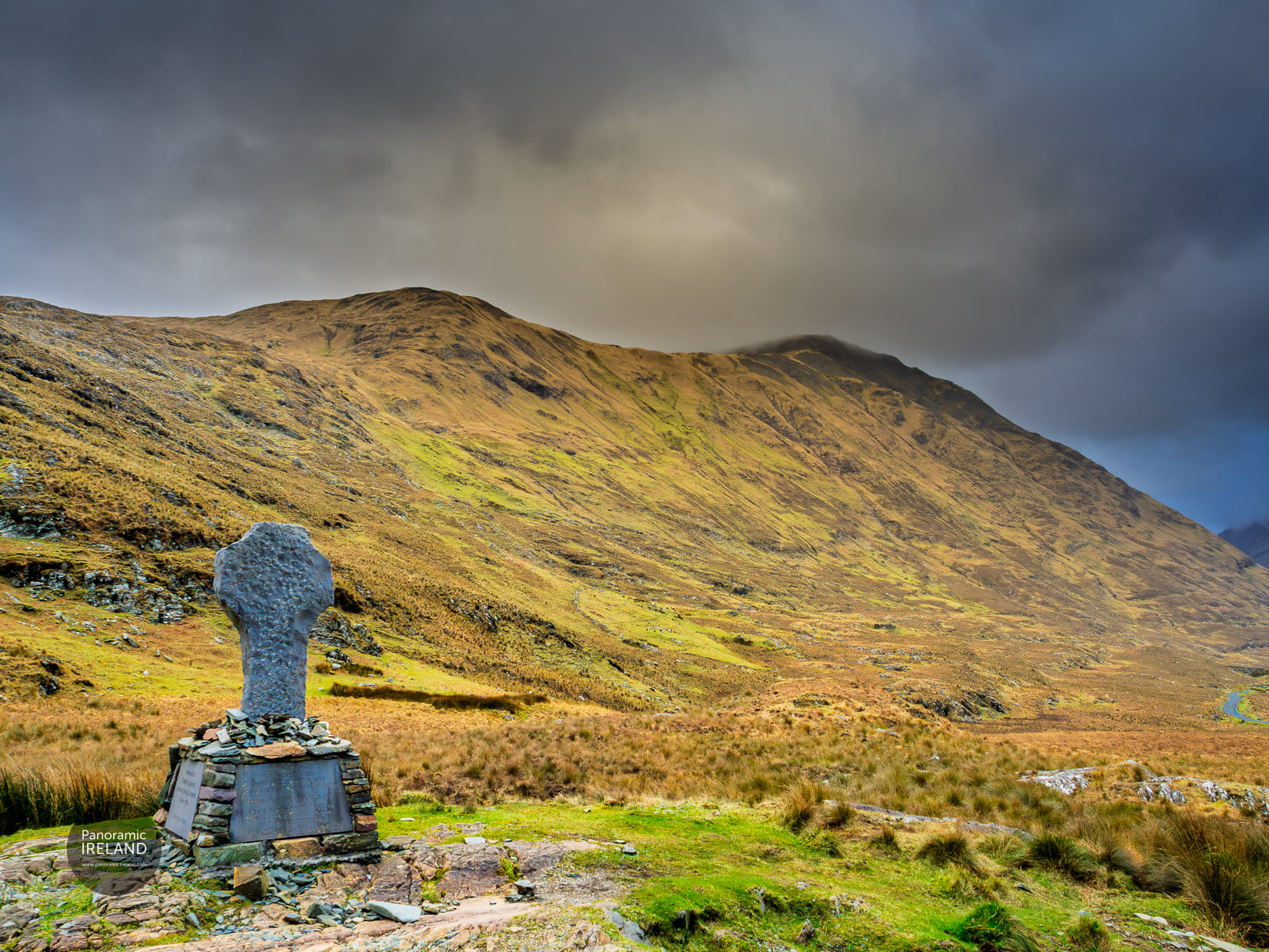
“How can men feel themselves honoured by the humiliation of their fellow beings?” Inscription on the memorial cross, Doolough Valley
The Doolough Tragedy is not, in the scale of the Famine, exceptional. That is, in some respects, the point. It was one episode among many in which the machinery of administration — inspections, relief registers, residency requirements — produced outcomes that, in other circumstances, would be clearly understood as cruelty. The people who walked to Delphi Lodge were not asking for very much. They were asking to remain on a list. This kind of deliberate misdirection has parallels in the modern world where we hear stories and see images of indigenous, local peoples who are told to move to a location “for their safety” only to be obliterated without warning.

Leave your comment
Comments are emailed to Panoramic Ireland and are not published automatically.
Thanks — your comment is in. We'll reply by email shortly.
Security check failed. Please complete the check below and try again.